
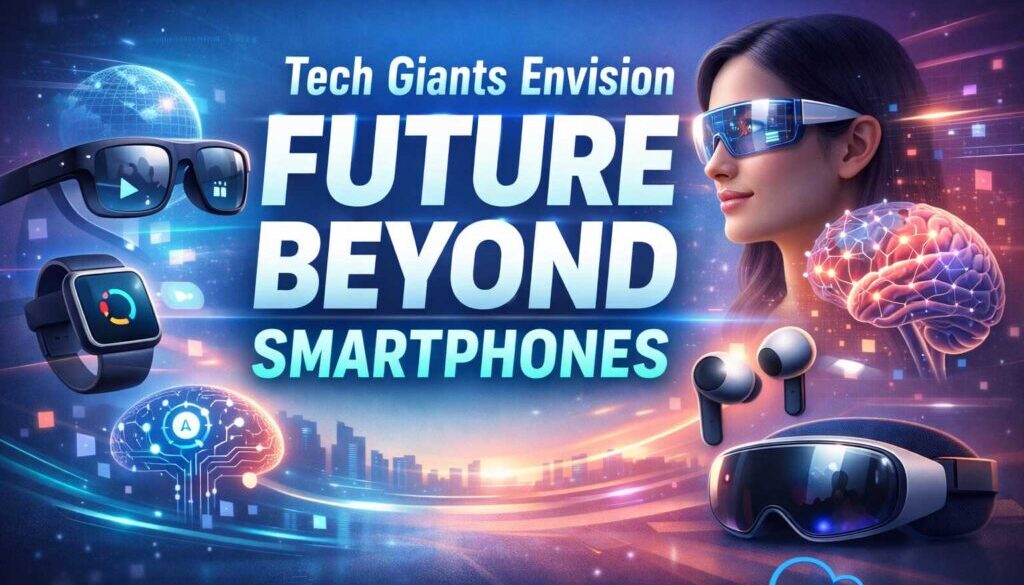
Tech Giants Envision Future Beyond Smartphones: What Comes Next?
For nearly two decades, the smartphone has been the most important device in most people’s lives. It replaced cameras, maps, wallets, and even laptops for millions of users around the world. But something is quietly shifting in the technology industry, and the biggest companies in the world are already preparing for it.
Today, tech giants are no longer racing to build better phones. They are investing billions of dollars into a completely new kind of technology. One that does not live in your pocket but wraps around your world. The future they are building is smarter, more invisible, and more personal than anything we have seen before.
Why the Smartphone Era Is Slowing Down
If you have noticed that your new phone does not feel that different from the one you had three years ago, you are not imagining it. Smartphone innovation has genuinely slowed. The cameras are sharper, yes, but the way we use the device has not changed much.
People are also holding onto their phones longer than ever before. The days of upgrading every year are mostly over for the average person. Battery life and durability have become more important than new features, and that shift tells tech companies something important: the phone has reached its ceiling.
This is not a crisis for the industry. It is actually an invitation. When one platform matures, the next one begins, and right now we are standing right at that edge.
The Vision: Technology That Disappears Into Life
The future that companies like Apple, Meta, Google, and Microsoft are building has a name in the tech world: ambient computing. The idea is simple but powerful. Instead of you reaching for a device, the technology comes to you. It surrounds you, listens to context, and responds without you having to stop what you are doing.
Imagine walking into a room and the information you need is already there, shown through lightweight glasses or spoken through smart earbuds. Your environment becomes your interface. There is no unlocking a screen, no opening an app, no staring down at a rectangle in your hand.
This shift is not science fiction anymore. It is already happening in early product releases and research labs, and the timeline is moving faster than most people realize.
AR Glasses: The Front Runner to Replace the Phone
Augmented reality glasses are currently the most visible bet being made in the post-smartphone race. These are glasses that overlay digital information onto the physical world around you. Think navigation arrows floating above a real street, or a message appearing in your field of vision without interrupting what you are doing.
Meta has made the boldest moves in this space with its Ray-Ban smart glasses, which have sold millions of units and continue to grow in popularity. The company has plans for more advanced versions that include built-in displays, with a full AR headset called Orion being developed as the long-term goal.
Apple is building toward lightweight AR glasses expected to arrive in the 2026 to 2027 window. Google is working on wearables powered by its Gemini AI that can understand your surroundings and answer questions without you needing to pull out a phone. The race for the face is very much on.
AI Is the Engine Powering All of This
None of these new devices would be possible without the massive leap in artificial intelligence that has happened over the past few years. AI is what allows a pair of glasses to understand what you are looking at, what you might need, and how to help you without being asked directly.
Agentic AI is one of the biggest concepts shaping this future. Unlike a simple voice assistant that answers questions, an AI agent can take action. It can book a flight, reschedule a meeting, or send a message on your behalf. When AI can do all of that through a wearable device, the need to open an app on a phone shrinks significantly.
Companies are also working on AI that is always on but never intrusive. The goal is an assistant that learns your habits, understands your context, and steps in only when it is actually useful. That kind of intelligence is what makes the post-smartphone dream believable.
Spatial Computing and the Role of Apple Vision Pro
Apple introduced the world to spatial computing with the Vision Pro headset. While it was expensive and not designed for everyday all-day use, it planted an important idea. Your physical space can become a screen. Digital content can live in a room alongside real objects, and you interact with it using your eyes, hands, and voice.
The Vision Pro showed what is possible when computing breaks free from flat screens. Future, lighter versions of this technology could change how people work, communicate, and consume content. Wearing a headset to take a video call or review a presentation could become as normal as opening a laptop today.
Spatial computing is not just about Apple. Samsung, Google, and Microsoft are all investing in mixed reality experiences that blend the digital and physical world. The competition in this space will likely produce faster breakthroughs and more affordable products over the next few years.
Brain-Computer Interfaces: The Most Ambitious Bet
At the far end of the post-smartphone spectrum sits brain-computer interface technology, often called BCI. This is the idea of communicating with digital devices directly through neural signals, without any physical input at all.
Neuralink, founded by Elon Musk, has already implanted its first human patients with a chip that allows them to control a computer cursor using thought alone. The accuracy rates in early trials have been promising. While this technology is currently focused on medical applications for people with paralysis, the long-term commercial roadmap points toward consumer use.
- BCI allows hands-free, voice-free device interaction
- Early versions are already being tested in clinical settings
- Consumer-grade non-invasive options like EEG headbands are already entering gaming and focus-based productivity
The BCI market is still in its infancy, but the investment flowing into the space signals that even the biggest companies see it as a real part of the future, not a distant fantasy.
Wearables Are Already Bridging the Gap
You do not have to wait for AR glasses or brain chips to experience the shift away from smartphones. Wearables are already changing how people interact with technology every day. Smartwatches, fitness rings, and advanced earbuds are handling more and more tasks that once required pulling out a phone.
Health monitoring has become a major driver of wearable adoption. Devices now track heart rate, blood oxygen, sleep quality, stress levels, and even irregular heart rhythms. As sensors become more accurate and smaller, wearables are becoming the primary health device for millions of users worldwide.
Smart earbuds are evolving into what some researchers call neural hearables. These are devices that go beyond audio and can read subtle physical signals from the body. Some early-stage versions allow users to control devices through jaw movements or other micro-gestures, making them a quiet but significant part of the post-smartphone picture.
The Challenges That Still Need to Be Solved
The path to a post-smartphone world is exciting, but it is not without real obstacles. Battery life remains one of the biggest engineering challenges. A pair of AR glasses that runs out of power after two hours is not going to replace a smartphone that lasts all day.
Privacy is another major concern. Ambient computing means devices are always listening, always watching, and always collecting data. For this technology to gain public trust, companies need to be clear about what data is collected, where it goes, and who has access to it. Without that transparency, consumer resistance could slow adoption significantly.
Cost is also a real barrier, at least for now. Early AR glasses, spatial computing headsets, and BCI devices are priced well beyond what most people can afford. History shows that technology prices fall over time as production scales up, but the transition period can take years, and billions of potential users will wait on the sidelines until prices come down.
What This Means for You
The smartphone is not disappearing tomorrow. Most people will continue using their phones for years to come, and that is perfectly fine. What is changing is the role the phone plays. It may gradually become a backup device rather than the center of your digital life.
The devices that will matter most in the next decade are the ones that fade into the background. A pair of glasses you forget you are wearing. Earbuds that feel like an extension of your thinking. A smart ring that monitors your health without you having to check an app.
The best technology tends to become invisible over time. Electricity, running water, and internet connectivity all started as remarkable novelties and became things we simply expect. The next generation of computing is heading in the same direction, and tech giants are placing very large bets that they can be the ones to build it.
Frequently Asked Questions (FAQs)
Q1: Are smartphones going to disappear completely?
No. Smartphones will remain useful for a long time, especially for tasks like typing, banking, and complex apps. What will change is how central they are. Over the next decade, other devices will likely handle more and more of the things we currently reach for our phones to do.
Q2: What technology will replace smartphones?
There is no single replacement. The post-smartphone era is about an ecosystem. AR glasses, AI-powered wearables, spatial computing headsets, and ambient AI systems will all work together to reduce the need for a handheld screen in daily life.
Q3: When will AR glasses become mainstream?
Early affordable AR glasses are already available in 2025 and 2026. Mainstream adoption, where most people own and regularly wear a pair, is generally expected to happen between 2030 and 2035 as prices drop and battery life improves.
Q4: Is brain-computer interface technology safe?
Current BCI technology being tested in humans is focused on medical applications with strict oversight. Non-invasive versions like EEG headbands are already available for consumers and considered safe. Implant-based BCIs are still in very early clinical stages and years away from any consumer release.
Q5: Which company is leading the post-smartphone race?
Different companies are leading in different areas. Meta is ahead in consumer smart glasses. Apple is pioneering spatial computing. Google is strong in ambient AI. Neuralink is the front runner in brain-computer interfaces. There is no single winner yet, and the competition is still wide open.
Q6: Will the shift beyond smartphones affect developing countries differently?
Yes, likely so. Smartphone adoption in many developing regions is still growing, and those users may skip some of the intermediate steps seen in wealthier markets. However, cost will be the biggest factor. Post-smartphone devices will need to become significantly cheaper before they can reach global audiences at scale.
———————–
Other Articles:
Multiple Severe Thunderstorm Alerts Issued for South Carolina Counties
Social Media Silent Scroller Traits: Who They Are and What Drives Them
Constantine Yankoglu: Inside The Life of Patricia Heaton’s Ex-Husband
Isac Hallberg: All About the Life of Ludwig Hallberg and Rebecca Ferguson’s Son
Jerome Jesse Berry: All About the Life of Halle Berry’ Father