
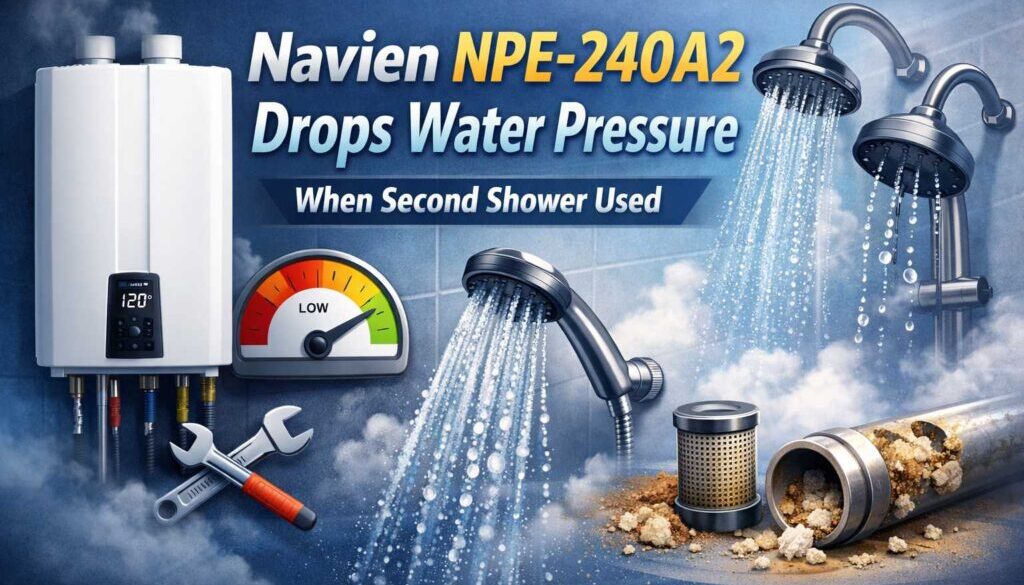
Navien Npe-240a2 Drops Water Pressure When Second Shower Used
If you own a Navien NPE-240A2 tankless water heater, you have probably noticed a frustrating pattern. Everything feels fine when one person showers, but the moment a second shower turns on, the water pressure drops noticeably. You are not imagining it, and you are definitely not alone in dealing with this.
This guide breaks down exactly why this happens, what you can do about it, and how to prevent it from coming back. Whether you are a homeowner trying to fix this yourself or just want to understand what your plumber is talking about, this article has everything you need.
What Is the Navien NPE-240A2?
The Navien NPE-240A2 is a second-generation condensing tankless water heater. It is designed to deliver hot water on demand, meaning it only heats water when you need it rather than storing it in a tank. This makes it highly energy efficient and a popular choice for modern homes.
The unit features dual stainless steel heat exchangers, a built-in recirculation pump through the ComfortFlow system, and the ability to handle significant hot water demand. At a moderate temperature rise, it can deliver around 8 to 11 gallons per minute, which is enough for most households under normal conditions.
However, “normal conditions” is the key phrase here. When demand spikes suddenly, like when a second shower kicks on, the unit has to work much harder. That extra stress can reveal several underlying issues that were invisible when only one fixture was running.
Why the Navien NPE-240A2 Drops Pressure When a Second Shower Turns On
The Unit Has to Split Its Output
Tankless water heaters do not have a reserve of hot water to draw from. When one shower is running, the unit is heating water at a steady rate to meet that demand. When a second shower opens, the total hot water demand almost doubles instantly.
The unit now has to heat more water at the same time while maintaining temperature. If the incoming cold water pressure or the gas supply is not strong enough to support that jump in demand, the unit compensates by reducing flow to each fixture. That is what you feel as a pressure drop.
This is not always a malfunction. Sometimes it is simply the unit operating near the edge of its capacity. But in many cases, there is a fixable problem underneath.
The Flow Sensor Is Struggling
The flow sensor is one of the most important components inside the NPE-240A2. It detects how much water is moving through the unit and tells the heater how hard to fire. When this sensor gets dirty, worn, or starts to fail, it sends inaccurate readings to the control board.
A sluggish or faulty flow sensor may underreport the actual flow, causing the unit to heat less aggressively than it should. When the second shower adds more demand, the sensor cannot keep up with the change, and pressure suffers as a result. Flow sensors on these units are known to degrade over time, especially if the water supply carries any sediment.
Low Incoming Water Pressure
Sometimes the problem has nothing to do with the heater itself. If your home’s incoming water pressure is already on the lower side, the unit will struggle more when demand increases. Most homes operate well between 60 and 80 PSI, but homes with older plumbing or pressure reducing valves set too low can fall below that range.
When a second shower turns on, total system demand increases, and the incoming pressure can drop enough to affect how much water flows through the heater. The result is weaker pressure at both showers simultaneously. Checking and adjusting your pressure reducing valve is often one of the simplest and most effective first steps.
Clogged Inlet Filter
The Navien NPE-240A2 has a cold water inlet filter screen that catches debris before it enters the unit. Over time, this filter can accumulate sediment, mineral deposits, and other particles. A partially clogged filter restricts how much water can enter the heater, which directly limits output.
Under light demand from a single shower, a mildly clogged filter may not cause noticeable issues. But when a second shower demands more flow, the restriction becomes obvious. Cleaning this filter is a straightforward maintenance task that homeowners can often handle themselves with the help of the owner’s manual.
Scale Buildup in the Heat Exchanger
Hard water areas are a common culprit for this problem. Mineral scale from calcium and magnesium builds up inside the heat exchanger over time. As scale accumulates, it narrows the internal water passages and reduces the efficiency of heat transfer.
The unit has to work harder to heat the same amount of water, and it cannot move water as freely as it once did. When demand surges with a second shower, the restricted passages simply cannot supply enough flow to both fixtures. Descaling the unit with an approved flush solution is the standard fix for this.
Temperature Set Too High
Many homeowners set their water heater to a high temperature thinking it means more comfort. In reality, a very high temperature setting on a tankless heater reduces its flow capacity. The unit can only transfer a certain amount of heat per minute, so heating water to a higher temperature means it heats less of it.
If your set point is at 130 or 140 degrees Fahrenheit, try lowering it to around 120 degrees. This is still safe and comfortable, but it allows the unit to push through more gallons per minute, which can make a meaningful difference when two showers are running.
Gas Supply Limitations
The NPE-240A2 runs on natural gas or propane, and it needs a steady, adequate gas supply to fire at full capacity. If the gas line feeding the unit is undersized for the load, the burner cannot reach full output. This problem often only shows itself during peak demand situations like running two showers at once.
Half-inch gas pipe can be used for short runs, but longer runs or installations with other gas appliances on the same line may require a larger pipe diameter. A qualified plumber or gas technician can test your gas pressure at the unit to confirm whether supply is adequate.
How to Fix the Pressure Drop Step by Step
Here is a practical sequence of steps to work through before calling a technician.
- Step 1: Check and clean the cold water inlet filter screen. Remove any sediment or mineral buildup.
- Step 2: Test your home’s incoming water pressure with a gauge on an outdoor hose bib. Adjust the PRV if pressure is below 60 PSI.
- Step 3: Lower your water heater temperature setting to around 120 degrees Fahrenheit.
- Step 4: Inspect the flow sensor for wear or debris. Clean the connections and consider replacing it if the unit is several years old.
- Step 5: Flush and descale the heat exchanger if you live in a hard water area and the unit has not been serviced recently.
- Step 6: Confirm that all shut-off valves on the water lines are fully open. A partially closed valve can choke flow quietly.
If these steps do not resolve the issue, the problem may require a licensed technician to inspect the gas supply, test the unit’s output flow directly, or evaluate whether a second unit is needed for the household’s demand.
When Is It a Capacity Problem, Not a Fault?
Sometimes the Navien NPE-240A2 is simply being asked to do more than it can handle. In homes with multiple bathrooms where several fixtures can run at once alongside appliances like a dishwasher or washing machine, the unit may reach its thermal ceiling.
At a larger temperature rise, the unit’s maximum flow rate is considerably lower. In colder climates where incoming water is very cold, the effective output drops significantly. This is not a malfunction. It is a sizing issue, and the solution may be adding a second unit or installing a small buffer tank to handle peak demand.
If your home has grown in occupancy or your hot water habits have changed since the unit was installed, it is worth reassessing whether the NPE-240A2 is still appropriately sized for your needs.
Preventive Maintenance Tips
Staying ahead of these problems is much easier than fixing them after the fact. Here are a few maintenance habits that keep the NPE-240A2 running at its best.
- Clean the inlet filter screen once a year, or more often if your water supply carries sediment.
- Flush and descale the heat exchanger annually if you have hard water.
- Have a technician check the flow sensor every two to three years as part of a routine service visit.
- Monitor your water pressure periodically and confirm the PRV is set correctly.
Consistent maintenance keeps the unit heating efficiently and reduces the likelihood of pressure drops under high demand.
Frequently Asked Questions (FAQs)
Q: Is it normal for the Navien NPE-240A2 to lose pressure when a second shower turns on?
A small pressure adjustment can be normal when demand suddenly increases, but a significant and noticeable drop is not. It usually points to a fixable issue like a dirty filter, low supply pressure, or a struggling flow sensor. It is worth investigating rather than accepting it as normal behavior.
Q: What is the maximum flow rate of the Navien NPE-240A2?
The unit is rated at approximately 11.2 gallons per minute at a 35-degree Fahrenheit temperature rise. At a larger temperature rise, such as 67 degrees, that rate drops to around 5.6 GPM. In colder climates, the effective output for two simultaneous showers can be tight depending on fixture flow rates.
Q: Can I fix the Navien NPE-240A2 pressure drop myself?
Many of the most common fixes are DIY-friendly. Cleaning the inlet filter, adjusting the temperature setting, checking the PRV, and flushing the unit with a descaling solution are all tasks a reasonably handy homeowner can do. For gas supply issues, flow sensor replacement, or internal diagnostics, a licensed plumber or Navien Service Specialist is the right call.
Q: How often should I clean the inlet filter on my Navien NPE-240A2?
Once a year is a good general guideline. If your water tends to carry sediment or you are in an area with hard water, checking it every six months is a better habit. A clogged inlet filter is one of the most common and easiest causes of reduced flow to fix.
Q: Will lowering the temperature setting really improve pressure?
Yes, it often does. A lower temperature setting means the unit heats each gallon of water less aggressively, allowing it to process more gallons per minute. Dropping from 130 to 120 degrees Fahrenheit can noticeably improve the available flow when two fixtures are running.
Q: When should I consider replacing or adding a second water heater?
If you have addressed all common causes and the unit still cannot keep up with your household demand, it may be a capacity issue. Homes with four or more bathrooms, multiple occupants, or high simultaneous fixture use may genuinely need a second unit or a different system configuration. A plumbing professional can help assess whether that is the right step for your situation.
Final Thoughts
The Navien NPE-240A2 is a capable and efficient tankless water heater, but like any appliance, it needs proper conditions and regular maintenance to perform at its best. A pressure drop when the second shower turns on is a common complaint, and in most cases, it has a clear and fixable cause.
Start with the simplest checks first: clean the inlet filter, verify your supply pressure, and consider your temperature setting. From there, work through the more involved steps if needed. With the right attention, the NPE-240A2 can comfortably handle two showers running at the same time, just as it was designed to do.
If you are ever unsure, contacting Navien’s technical support line or reaching out to a certified Navien Service Specialist is always a smart move. They can walk through the diagnostics with you and help identify whether a part or a setting is the issue.
————————
Other Articles:
Multiple Severe Thunderstorm Alerts Issued for South Carolina Counties
Divorceoumonop: How It Helps Thousands Navigate Life After Divorce
Social Media Silent Scroller Traits: Who They Are and What Drives Them
Constantine Yankoglu: Inside The Life of Patricia Heaton’s Ex-Husband
Tech Giants Envision Future Beyond Smartphones: What Comes Next?