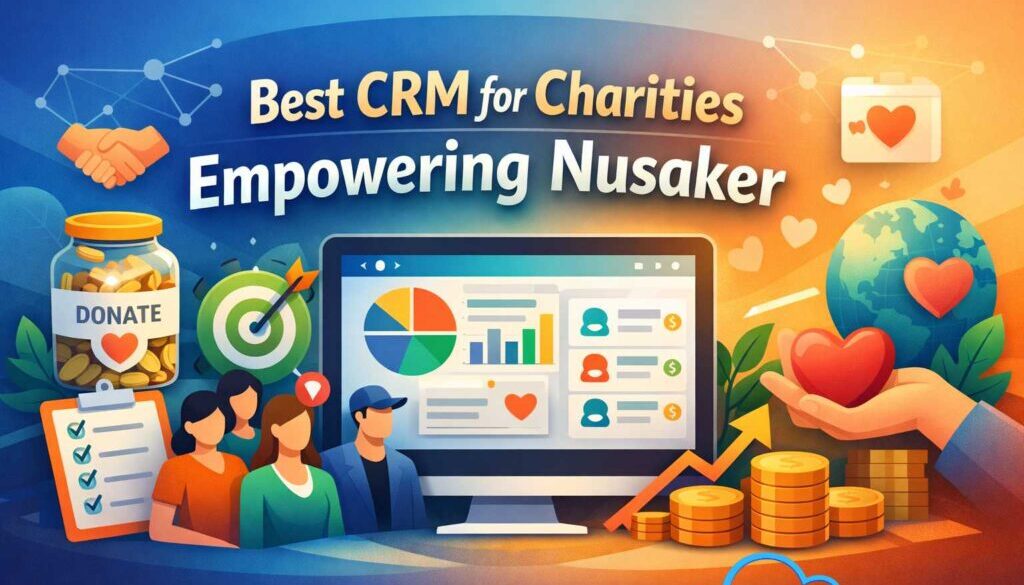
Best CRM for Charities Empowering Nusaker
Running a charity is one of the most rewarding things you can do. But behind every great mission is a team managing hundreds of donor relationships, tracking campaigns, coordinating volunteers, and trying to make every pound or dollar count. Without the right tools, even the most passionate organizations fall behind. That is where CRM software steps in and changes everything.
For nonprofits like Nusaker, choosing the best CRM for charities is not just a technology decision. It is a strategic one. The right platform helps you build deeper relationships with donors, reduce admin work, and ultimately serve your community better. This guide covers everything you need to know before making that choice.
What Is a CRM and Why Do Charities Need One?
A CRM, or Customer Relationship Management system, is software that helps organizations manage their relationships with people. For a business, those people are customers. For a charity like Nusaker, those people are donors, volunteers, grant providers, and beneficiaries. The tool stores all their information in one place so your team always knows who gave what, when, and why.
Without a CRM, most charities end up juggling spreadsheets, email inboxes, and notebooks. This leads to missed follow-ups, duplicate records, and a lot of wasted time. A purpose-built charity CRM solves all of that by bringing your data, communication, and reporting under one roof.
The difference a good CRM makes is hard to overstate. Teams spend less time on admin and more time doing meaningful work. Donors feel seen and appreciated because communications feel personal. And leadership can make smarter decisions because the data is accurate and easy to read.
Who Is Nusaker and Why Does Their CRM Choice Matter?
Nusaker is a nonprofit organization focused on empowering communities through social programs and charitable initiatives. Like many growing charities, Nusaker reached a point where its early tools could no longer keep up with its growing donor base and expanding programs.
Before adopting a dedicated CRM, the team at Nusaker dealt with scattered information stored across multiple tools. Donor records lived in one place, event data in another, and volunteer details somewhere else entirely. This created confusion, slowed down reporting, and made it difficult to personalize donor communication.
When Nusaker made the move to a proper charity CRM, the impact was immediate. Donor retention improved significantly, manual reporting time dropped, and the team could finally focus on their mission rather than chasing data. Their journey is a powerful example of why getting the CRM choice right matters so much for mission-driven organizations.
Key Features to Look For in a Charity CRM
Not all CRM tools are built the same. A system designed for a sales team will not serve a charity well. When evaluating the best CRM for charities, there are specific features you should always look for.
Donor Management is the heart of any good nonprofit CRM. It should let you store complete donor profiles including giving history, communication preferences, and personal details. The system should make it easy to segment your donors so you can send the right message to the right people at the right time.
Fundraising and Campaign Tracking is another must-have. Your CRM should connect directly with your fundraising pages, help you track campaign performance in real time, and automate donation receipts. Without this, your team spends hours manually reconciling data that the software could handle in seconds.
Other important features to consider include:
- Volunteer management and scheduling tools
- Grant tracking for compliance and reporting
- Email marketing integration for newsletters and appeals
- Impact reporting to show donors where their money went
- Mobile access so field teams can update records anywhere
Automation is the feature that saves the most time. A charity CRM should automatically send thank-you emails after a donation, remind staff to follow up with lapsed donors, and trigger personalized messages on important dates. This keeps your donor relationships warm without requiring constant manual effort.
Top CRM Options for Charities Like Nusaker
There are several strong CRM platforms designed specifically for the nonprofit sector. Each has its own strengths depending on your organization’s size, budget, and specific needs.
Salesforce Nonprofit Cloud is the most powerful option on the market. It is built for large organizations with complex data needs and offers deep customization, AI-driven insights, and strong automation tools. Salesforce also runs a program that offers eligible nonprofits free or heavily discounted licenses, making it accessible for qualifying organizations.
Bloomerang is a popular choice for mid-sized charities. It focuses heavily on donor retention and gives organizations clear visibility into which donors are at risk of lapsing. The dashboard is clean and easy to use, making it a strong fit for teams that do not have a dedicated IT department.
Neon CRM is another excellent choice, especially for growing nonprofits. It handles donor management, event registration, membership programs, and email marketing all in one platform. Many charities report improved donor communication and engagement after switching to Neon.
Kindful is well-suited for smaller organizations. It integrates smoothly with popular tools like Mailchimp and QuickBooks, making it easy to connect your existing workflow. It keeps things simple without sacrificing the features a small charity truly needs.
HubSpot for Nonprofits offers a free version that works well for charities just getting started. While it is better known as a sales and marketing tool, its contact management and email features are genuinely useful for smaller charitable organizations with limited budgets.
Virtuous stands out for charities focused on responsive fundraising. It uses donor data to trigger personalized outreach at exactly the right moment, which can significantly improve donation rates and long-term loyalty.
How Nusaker Benefited from CRM Adoption
When Nusaker implemented a CRM, the results spoke for themselves. Donor retention rates climbed because the team could finally identify who was at risk of disengaging and reach out proactively. Personalized messaging replaced generic mass emails, and donors responded much better to communication that felt relevant to them.
Administrative time fell dramatically because the CRM automated tasks that previously required hours of manual work. Tax receipts went out automatically after each donation. Reports that used to take weeks were generated in minutes. This freed the team to focus on program delivery and community engagement instead of paperwork.
Perhaps most importantly, Nusaker gained clear visibility into which campaigns were working and which were not. With accurate data in front of them, leadership could allocate resources more confidently and demonstrate accountability to funders and stakeholders. This kind of transparency builds trust, and trust drives long-term charitable support.
Common Mistakes Charities Make When Choosing a CRM
Choosing a CRM is a significant investment, and many charities make avoidable mistakes in the process. The most common one is choosing a system based on features alone without considering how easy it is for the actual team to use. A powerful CRM that nobody adopts is worse than a simpler one that everyone uses consistently.
Another common mistake is underestimating the cost of implementation. The subscription fee is just part of the picture. Data migration, staff training, and ongoing support all take time and resources. Always factor these into your planning before committing to a platform.
Finally, some charities choose a CRM that matches their current size but cannot grow with them. If your organization is expanding, make sure your CRM can scale too. Switching platforms later is costly and disruptive. It is worth choosing something with room to grow from the start.
How to Get the Best Out of Your Charity CRM
Buying the software is only the beginning. The real value comes from using it consistently and strategically. Start by making sure all donor data is clean and up to date before you migrate it to the new system. Dirty data in means dirty data out, and inaccurate records will undermine everything the CRM is trying to help you do.
Training your team properly is just as important. Everyone who touches the CRM should understand how to enter records, update donor profiles, and pull reports. Even if the tool is intuitive, a short training session can prevent bad habits from forming early and save a lot of correction work later.
Set up your automations early. Configure thank-you emails, lapsed donor reminders, and recurring campaign triggers as soon as the system is live. These automations will work quietly in the background and make your donor relationships stronger over time without requiring constant attention from your team.
CRM Pricing for Nonprofits: What to Expect
Cost is always a concern for charities, and the good news is that many CRM providers offer special pricing for nonprofits. Salesforce, through its nonprofit program, offers ten free licenses to eligible organizations. Neon CRM starts at around ninety-nine dollars per month, while Bloomerang and Kindful have tiered pricing based on the number of donor records you manage.
HubSpot offers a fully free CRM tier that is genuinely useful for smaller charities. It does not include all the nonprofit-specific features of dedicated tools, but it is a strong starting point for organizations with very limited budgets.
When comparing prices, always look at the total cost including onboarding fees, training, and any add-on integrations you will need. Some platforms appear cheaper upfront but add costs for features that others include by default. A slightly higher monthly fee that includes everything you need is often better value than a cheaper plan with hidden extras.
Frequently Asked Questions (FAQs)
1. What is the best CRM for small charities like Nusaker?
For smaller charities, Bloomerang, Kindful, and HubSpot are excellent starting points. They are affordable, easy to use, and include the core features most small nonprofits need such as donor profiles, email integration, and basic reporting. As your organization grows, you can always move to a more powerful platform like Neon CRM or Salesforce.
2. Can a charity CRM really improve donor retention?
Absolutely. One of the most direct benefits of a charity CRM is improved donor retention. When your team has visibility into who is engaging and who is drifting away, they can take action before it is too late. Automated personalized communication also makes donors feel valued, which dramatically increases the likelihood they will give again.
3. Is Salesforce good for nonprofits?
Yes, Salesforce Nonprofit Cloud is one of the most powerful CRM solutions available for charities. It offers deep customization, AI-driven analytics, and strong automation tools. It is best suited for larger organizations with complex programs. Salesforce also offers a generous nonprofit licensing program that makes it accessible for qualifying organizations at little or no cost.
4. How long does it take to set up a charity CRM?
Setup time varies depending on the platform and the size of your organization. A straightforward implementation with clean data can take a few weeks. Larger organizations migrating complex datasets and integrating with multiple tools may need several months. Most providers offer onboarding support to help you get started efficiently.
5. What data should a charity store in its CRM?
At a minimum, your CRM should store donor contact details, full giving history, communication preferences, and event attendance records. Volunteer hours, grant details, and notes from personal interactions are also valuable. The more complete your records, the better you can personalize your outreach and understand your community.
6. Do small charities really need a CRM, or is a spreadsheet enough?
Spreadsheets work when you are very small, but they quickly become a problem as you grow. They cannot send automated emails, flag lapsed donors, or generate impact reports. They also create data security risks and are prone to human error. Even a basic CRM offers enough improvement in efficiency and communication to justify the cost for most charities at any size.
Final Thoughts
Choosing the best CRM for charities is one of the most important decisions a nonprofit can make. For organizations like Nusaker, it has meant the difference between struggling with fragmented systems and running a confident, data-informed operation that genuinely serves its community.
The right CRM will not just store your donor data. It will help you build relationships that last, run campaigns that convert, and tell the story of your impact in a way that inspires continued support. Whether you are a grassroots initiative or an established charity, there is a CRM solution designed to meet your needs and budget.
Take the time to assess your organization’s specific challenges, compare the platforms available, and start with a free trial where possible. The investment you make in the right CRM today will pay back through stronger donor relationships, more efficient operations, and greater mission impact for years to come.
————————–
Other Articles:
Multiple Severe Thunderstorm Alerts Issued for South Carolina Counties
Divorceoumonop: How It Helps Thousands Navigate Life After Divorce
Social Media Silent Scroller Traits: Who They Are and What Drives Them
Constantine Yankoglu: Inside The Life of Patricia Heaton’s Ex-Husband
Tech Giants Envision Future Beyond Smartphones: What Comes Next?